

A Space Where Culture Thrives
"Allow this park to be a foundation or a blank page to tell our stories to the next generation. May it be a space that culture thrives as we keep alive the essence of what it means to be Dallas."
— Black Ceasar, 2026–2028 Dallas Poet Laureate, at the opening of Halperin Park, May 9, 2026
Standing on the speckled terrazzo of a New York City hospital, I peered down the corridor, clipboard in hand, and tried to picture what it could become. The hallway was long, unbroken, and offered nothing to move toward.
Space was tight — it always is in New York — and the constraints were real. But a few things were non-negotiable.
There had to be a destination. Something at the end of the hall worth moving toward — a window, a painting, a place the light changed. There had to be continuous handrailing along the walls, so a patient who needed support could find it without asking. There had to be places to rest — small inlets carved into the corridor where, if someone's legs gave out halfway, they could rest. Not turn back. Just stop, and then keep going. And the floor had to tell the story of progress: colored strips marking distance, quietly, so a patient and their physical therapist could see together how far they'd come, and set their sights on going a little further.
None of this was glamorous design. It was functional— built around a specific human truth: when nothing we do seems to make a difference, we stop trying. The environment can either confirm that powerlessness — or create the openings where we feel agency over our own lives again..
Psychologist Albert Bandura called it self-efficacy — the belief that our actions can make a difference. Not ability. Belief. And he found it isn't built through encouragement or willpower. It's built through small experiences of effort actually mattering.
And it doesn't stop at the physical. The environment shapes whether we believe our contributions — our ideas, our culture, our presence — are worth offering at all. A corridor that asks too much doesn't just stop a body from moving. It stops a person from believing movement is something people like them do.
The same logic holds at every scale.
This month, a park opened in Dallas that colleagues at HKS and SWA have been building toward alongside the community for nearly a decade. I wasn't on the project team. But I was in an early community meeting in the Tenth Street neighborhood six years ago — listening as neighbors talked about what they'd lost and what they hoped for. What I heard stayed with me. So did the question underneath it: what does it actually take to give a community back what infrastructure removed?
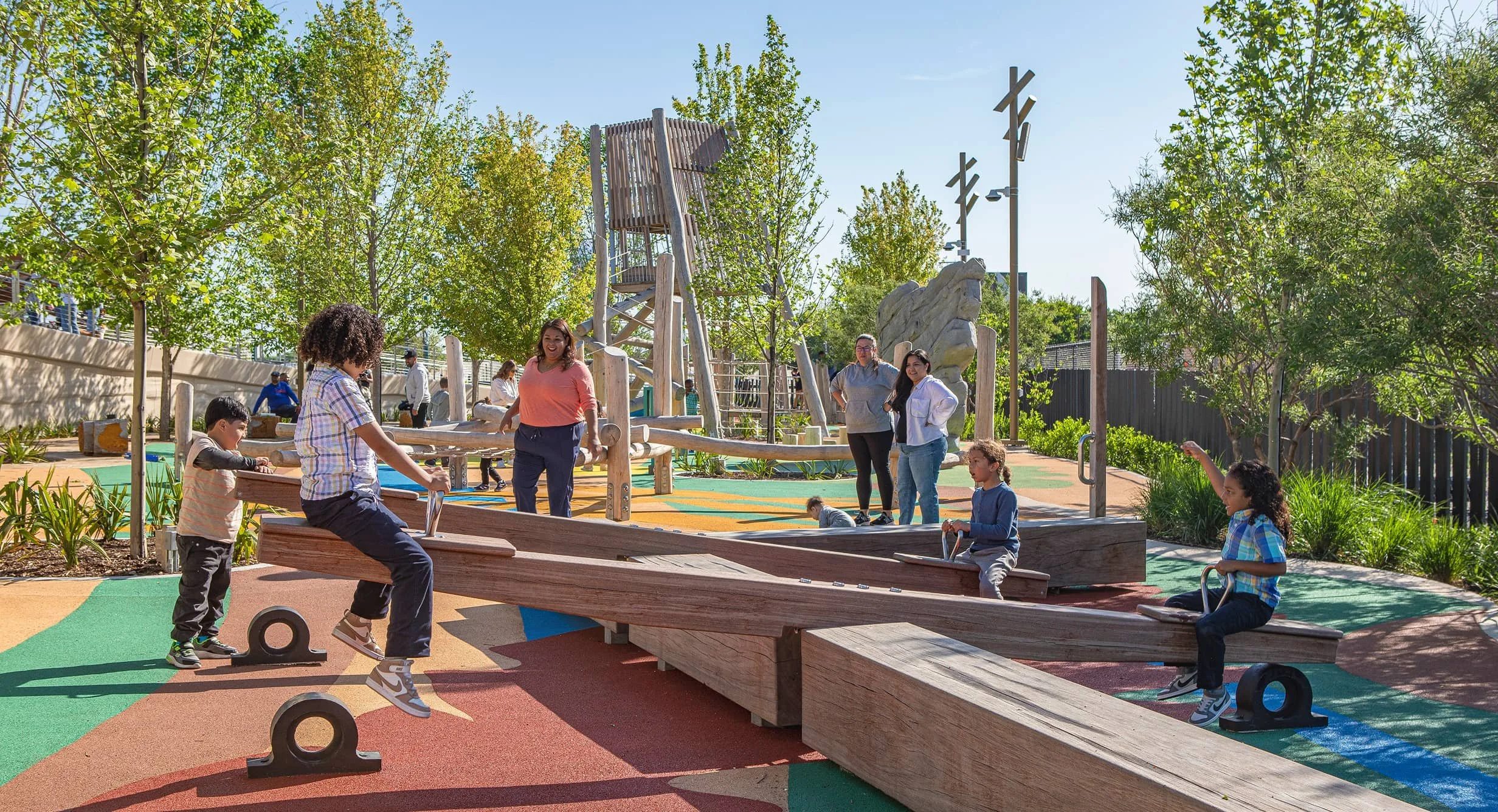
Halperin Park is built on a structural deck over 14 lanes of I-35E. It restores the 12th Street Promenade — a walkable connection that was simply erased. A great lawn, a performance shell, gardens, an inclusive playground, a multipurpose pavilion. Six schools within a mile. More than 500 residents shaped its design. Every community meeting was held bilingually. The landforms echo the limestone and chalk beneath Oak Cliff's own soil.
At the opening, Dallas’ Poet Laureate stood at the microphone, as children ran through the water and families lingered on the lawn. Council member Maxie Johnson said what the process had always been about: "This is what happens when we build the community with the community."
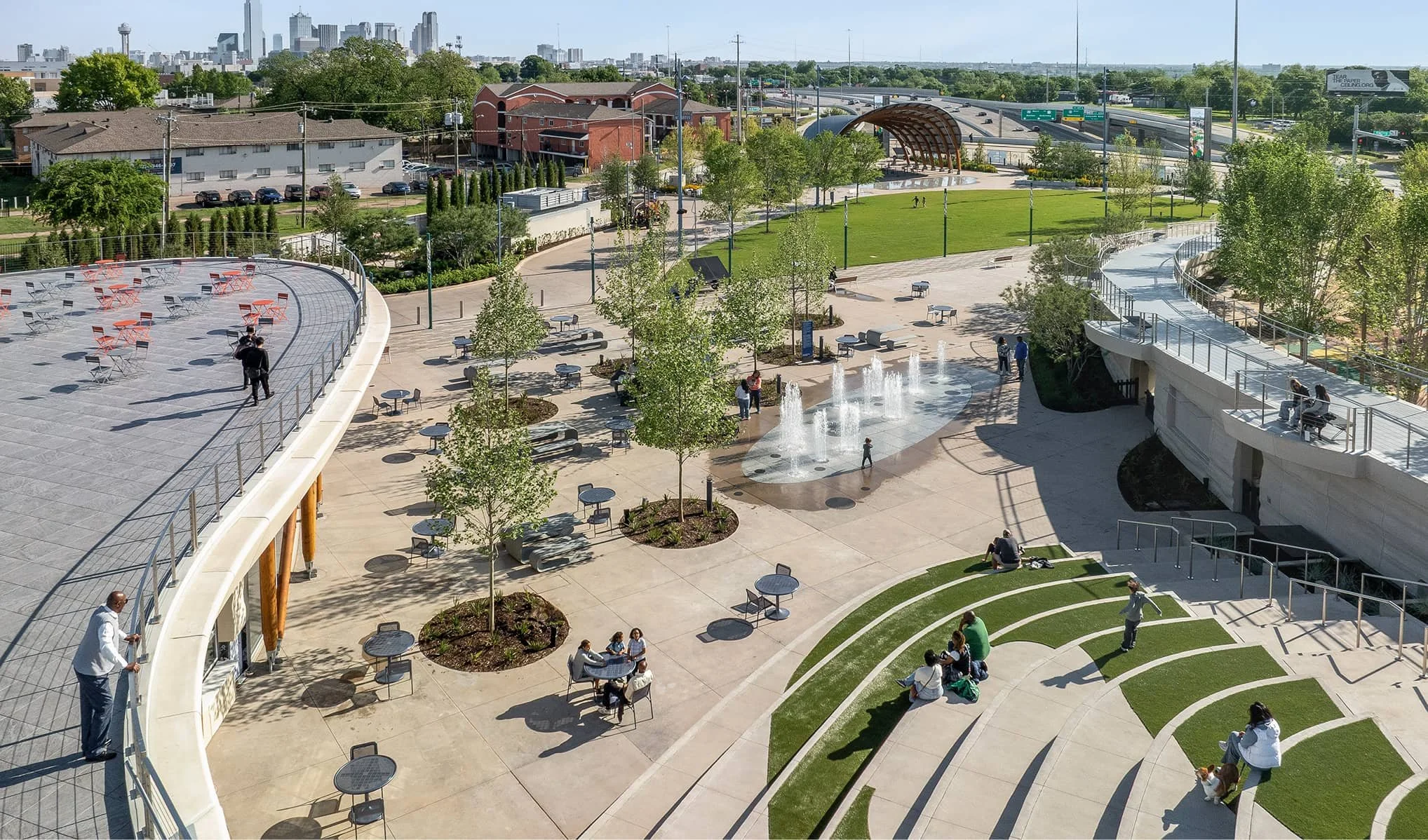
When I-35E—the highway that Halperin Park now spans—was built through Dallas in the 1950s, it cut through the Tenth Street neighborhood, a Freedmen's town established after the Civil War, once home to a retail corridor second only to downtown Dallas. It didn't just divide the community geographically. It severed the conditions that make daily life possible and community visible: the walkable destinations, the repeated casual encounters, the streets where a community's culture was visible and alive. Over subsequent decades, disinvestment compounded what the concrete began. Historic structures dwindled. And with them, something harder to measure: the built evidence that this community's expression was worth building for.
Self-efficacy lives not just within a person. It lives in the place around them — and shapes the culture that place either supports or quietly erases.
Repair is not restoration. After my own surgeries, my body was never exactly what it had been — but it could bear weight again. It could move. What changed was what became possible.
Halperin Park is not Tenth Street before the highway. It is Tenth Street with its ground back — and somewhere to keep writing what comes next.
Bridging a highway isn't always possible. But the logic holds everywhere — in a fire hydrant opened on a hot afternoon, a bench placed where someone might actually need to sit, a corridor designed so the patient at the end of it believes there is somewhere worth going.
Did someone design this in a way that makes it worth trying? The answer shapes whether people believe their presence is possible. Whether their culture has somewhere to land.
Halperin Park is a project of HKS and SWA, in partnership with the Southern Gateway Public Green Foundation. Learn more.
Further reading:
Self-Efficacy Research — how confidence in our ability to navigate life shapes wellbeing and resilience.
Park Access and Older Adults — research on how nearby green spaces support physical, mental, and social health in aging populations.
The Equigenic Effect— exploring how access to nature and public space can reduce health inequalities across communities.
