

What We Misunderstood About Loneliness This Year
This year, loneliness showed up everywhere - in headlines, health reports, workplace conversations, and quiet personal confessions.
We named it as a public health concern, talked about it more openly than we have in decades, and urged people to reach out, check in, and be more connected. And yet, for many, the feeling didn’t lift.
If anything, it became more pronounced. That gap - between our growing awareness of loneliness and our limited success in easing it - is worth paying attention to.
When Effort Isn’t Enough
Much of our response this year focused on individual action. We encouraged people to reach out, to check in more often, to be braver about naming their feelings and more intentional about maintaining relationships.
Those efforts matter, and they come from a place of care. But taken together, they also reveal an assumption: that loneliness is primarily something individuals must solve, through effort, vulnerability, or better habits.
When so many people are trying - and still struggling - it’s worth asking whether effort alone can carry the weight we’re placing on it.
How Environments Quietly Shape Connection
Loneliness doesn’t only take shape inside people; it takes shape in the conditions they move through every day. In the rhythms of work and school, in how healthcare is organized, in neighborhoods designed for speed rather than presence, and in public spaces that no longer invite people to linger.
These contexts don’t determine how we feel, but they quietly influence what kinds of interaction are easy, what kinds are awkward, and what kinds rarely happen at all. Over time, those signals accumulate - shaping not just behavior, but expectation.
When we focus exclusively on personal solutions, we risk overlooking the role of environments and systems in making connection more or less possible. A waiting room that discourages conversation, a workplace that leaves no time for informal exchange, a neighborhood with nowhere to gather except places that require spending money -none of these cause loneliness on their own.
But together, they narrow the pathways through which social life can unfold. They ask more of individuals while offering them less in return.
Signs of Something Better
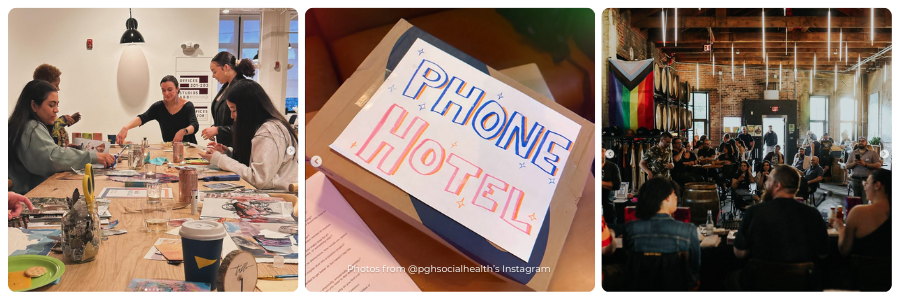
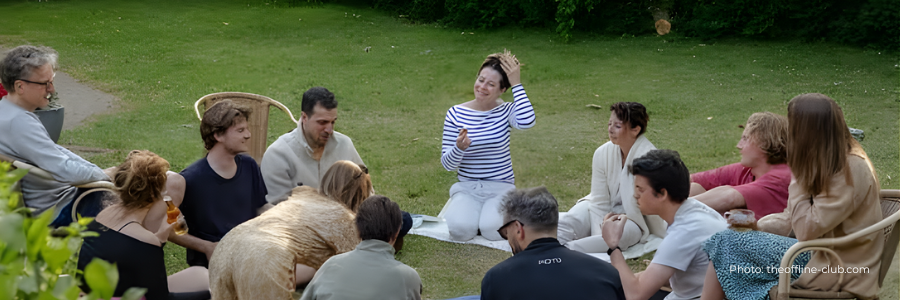
That said, there are bright spots. Around the world, The Offline Club organizes unplugged events that invite people to genuinely connect offline, away from screens and distractions.
In the United States, Pittsburgh Social Health hosts unique events in third spaces around the city, bringing people together in informal, accessible ways to foster belonging. And closer to home, in my own neighborhood, I’ve seen firsthand how small, human-scale interventions - like the lending library I designed with my daughter in our yard - can create spaces where connection happens organically.
If loneliness is shaped as much by these conditions as by individual choice, then our growing awareness of the problem may not be enough. It may even be misdirected.
The question that lingers for me at the end of this year isn’t whether people should try harder to connect, but whether we’ve been paying close enough attention to the environments and systems that quietly shape how possible connection feels in the first place.
A Closing Thought
As the year closes, I’m less interested in asking people to do more than in asking what might happen if we slowed down on purpose.
If loneliness is shaped by conditions, then pace matters.
So my invitation is simple: choose one small way to linger where you’d usually rush - at a table, in a shared space, with someone nearby - and notice what becomes possible. That, too, is a way of taking loneliness seriously.
Learn More
If you’re curious to explore the ideas behind this conversation, these articles and conversations are a great place to start:
On Flourishing: Esther Sternberg’s latest piece for Psychology Today unpacks what it really means to flourish—biologically, emotionally, and socially.
On Public Space: NYC DOT’s Curb Enthusiasm podcast features NYU professor Eric Klinenberg on how sidewalks, streets, and shared spaces quietly build stronger cities. Watch the episode here.
For the Science-Minded: A special issue on Loneliness & the Built Environment explores how the spaces we design influence connection, belonging, and isolation