

Is It the Suburbs, or How They're Designed?
What:
New research on more than 60,000 U.S. neighborhoods asks a sharp question: is suburban isolation really about being far from downtown, or about how the streets themselves are designed? Turns out, distance mostly matters in the first few miles outside the city. Design's effect doesn't fade with distance at all. It shows up just as strongly whether a neighborhood sits five miles from downtown or forty.
So What:
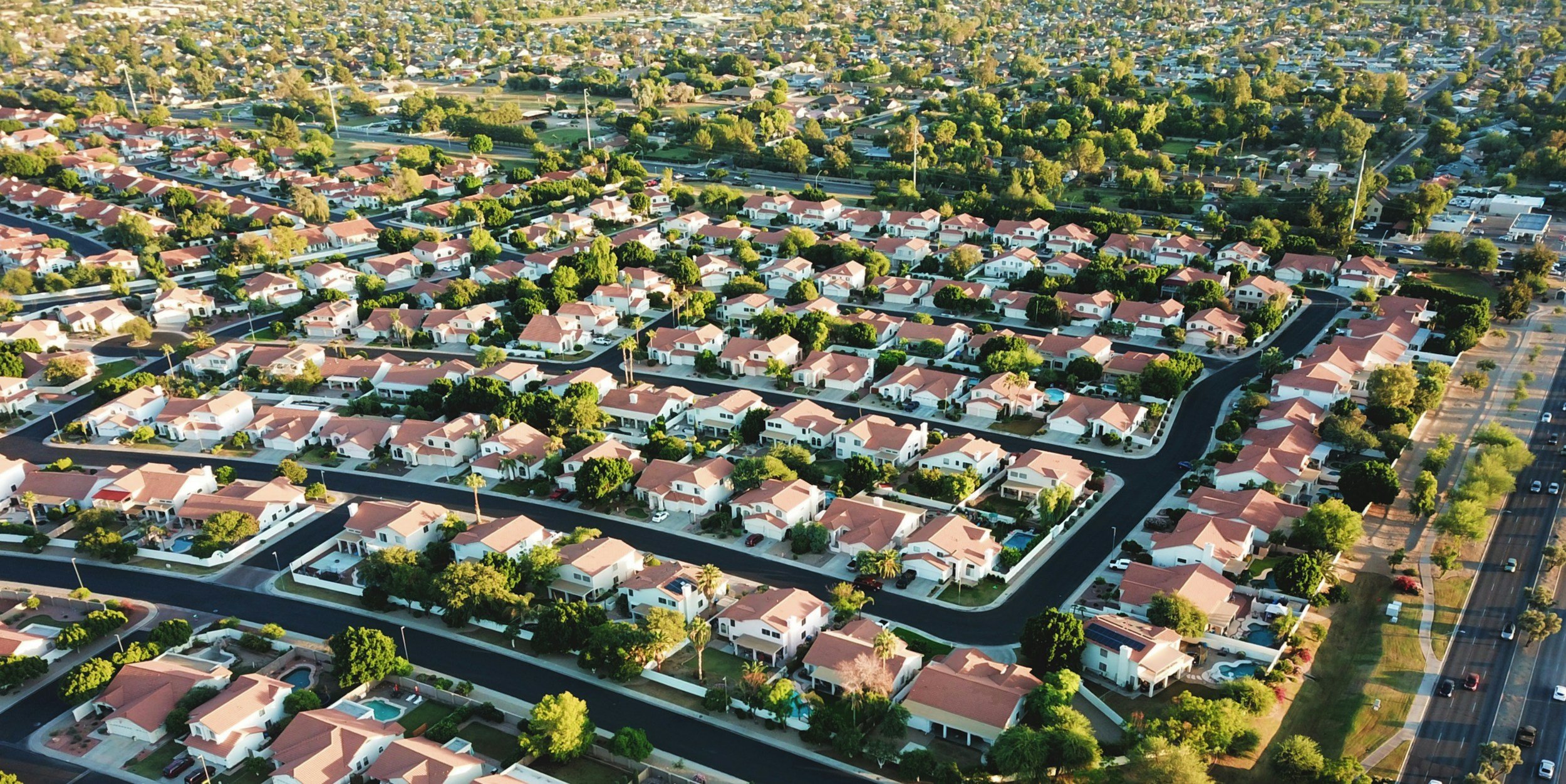
The design that built suburbia. Picture the classic postwar suburb: winding roads, quiet cul-de-sacs, everything tucked away from noise and traffic. That wasn't an accident. It was a design philosophy called Garden City Design (GCD), the winding-road, cul-de-sac style imported from early 20th-century Britain that became the blueprint for American suburbia after World War II. The goal was peace, beauty, retreat. It wasn't only a suburban trend, either. This style spread at every distance from downtown, near and far alike, as a nationwide fashion in planning.
What the study found. Arianna Salazar-Miranda, at the Yale School of the Environment, scored more than 60,000 U.S. neighborhoods on the features that define this style: curvy streets, cul-de-sacs, organic block shapes, and road hierarchies that funnel traffic onto major arterials. Using anonymized phone-mobility data, EPA emissions estimates, and three separate statistical approaches, including one designed to isolate cause from coincidence, she measured the effect on three outcomes: greenhouse gas emissions, time spent at home during waking hours (a proxy for sedentary behavior), and exposure to non-residents (a proxy for social isolation).
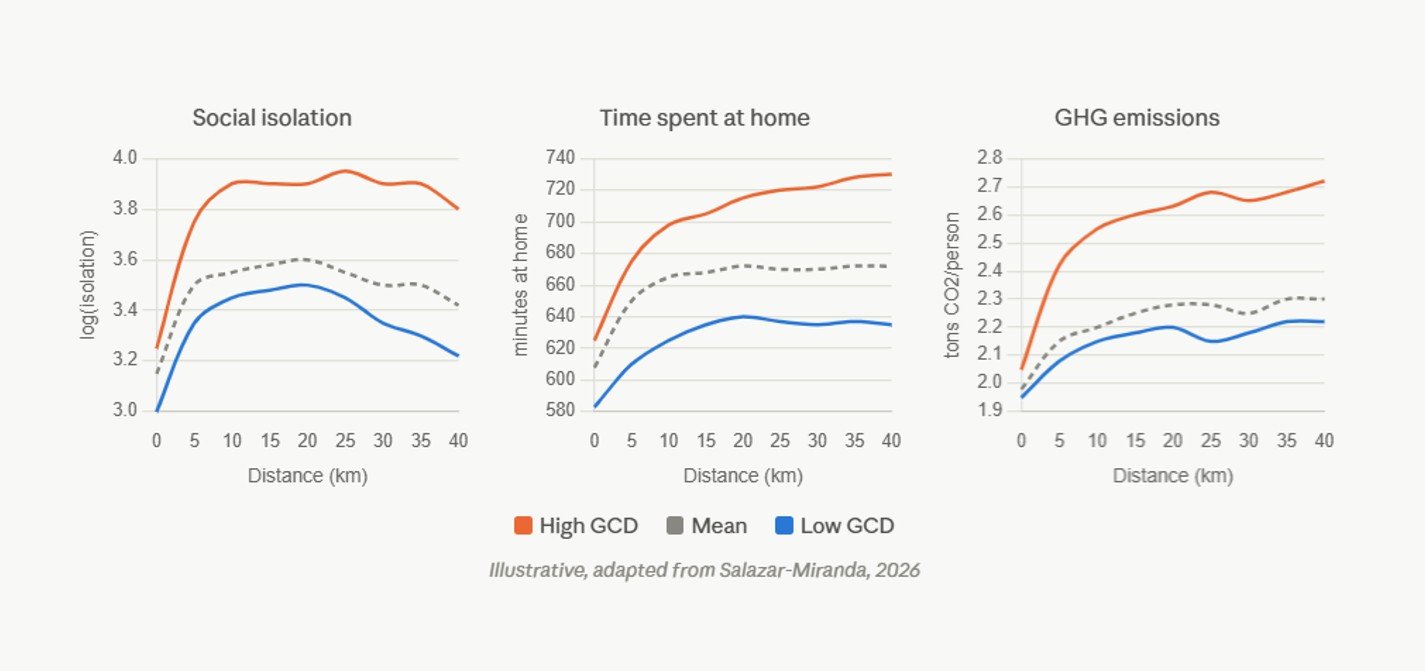
Benchmarking the effects of Garden City Design (GCD) vs. remoteness on neighborhood outcomes. a–c, Results for social isolation (a), daily time at home (b) and annual GHG emissions per capita (c). (Salazar-Miranda, 2026)
Neighborhoods that scored high in Garden City Design came out worse on all three measures of health. Design alone accounted for 27 to 38 percent of the isolation, sedentary time, and environmental costs we usually attribute to "sprawl" as a whole, depending on the outcome. Two neighborhoods equally far from the city center can produce very different lives, depending on whether their streets connect outward or curl in on themselves.
Why this matters to me. Most explanations of loneliness are explanations of character. We're too busy, too guarded, too much on our phones. This research points somewhere else. It points at the ground plan. Connection is built from repeated, low-stakes, slightly involuntary contact: the neighbor you pass on foot, the corner store where you become a regular. A layout that removes those occasions removes the raw material of acquaintance, no matter how warm the people living there are.
What we can actually change. We tend to treat social health, physical health, and environmental health as three separate problems with three separate solutions. This research suggests they share more than we think. And because these outcomes trace back to specific, adopted design choices, not just distance from downtown, they can be redesigned. Boston and San Francisco have removed highways to reconnect neighborhoods. Washington State has invested in local street and pedestrian connections. Portland requires new developments to build frequent street connections.
Now What:
Next time you move through your neighborhood, trace one everyday trip: groceries, coffee, a friend's house. Notice whether the route is direct because someone designed it to connect, or long because someone designed it to retreat. You'll start seeing the decisions embedded in the pavement. This wasn't inevitable, and it isn't permanent. The walkable route, the active route, and the low-carbon route are usually the same one.
Go Deeper:
This study references the work of Distinguished Professor of Sociology, Dr. Mario Luis Small. Click here learn moreabout his work on social ties.
For more on designing places that serve both people and planet, listen to my Shared Space conversation with Nico Larco: Sustainable Connections: Socially Vibrant Cities and Suburbs. His co-authored book, The Sustainable Urban Design Framework, gives practitioners concrete tools for building communities that are sustainable in every sense of the word.
Read more on the research: Yale School of the Environment (Salazar-Miranda, 2026)