

How You Arrive Shapes Who You Know
What school pickup reveals about designing for connection.
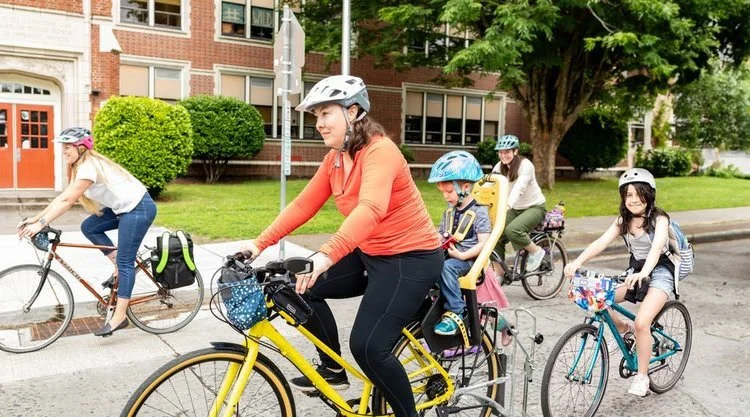
It was one of those early fall mornings in Texas when the air finally remembers it doesn't have to be brutal — dewy, soft, the sun coming through the clouds in a way that makes everything look like it's been rinsed clean overnight. I was on my bike. My daughter was on hers.
We pulled up to school and I saw a friend — another parent, someone I'd been in the same orbit as for a year without talking with as much as I would have liked. I dropped off my daughter, and stopped to chat. She told me about her new job. We talked about the girls, their classes, whether we were going to the movie night the following week. I hadn't known about the movie night. I knew about it now.
The whole conversation was maybe six minutes.
When I drop her off by car, the most I can manage is a wave. Usually nobody lingers long enough for even that.
Same school. Same parent. The only variable was how I arrived.
Those six minutes were doing more than they appeared to be doing.
The relationships at the edges of our social lives — the parent you've been in the same orbit as for a year without quite knowing — carry more useful information and diffuse support than our close friendships often do. Your close friends mostly know what you already know. She knew things you didn't. A job. A movie night. A change happening in the school community you hadn't heard about yet.
Most of those ties are not maintained through effort or intention. They're maintained by the simple structural fact of being in the same place at the same time often enough that recognition accumulates. The conversation doesn't have to be significant. It just has to happen.
The bike made it happen. The car makes it nearly impossible.
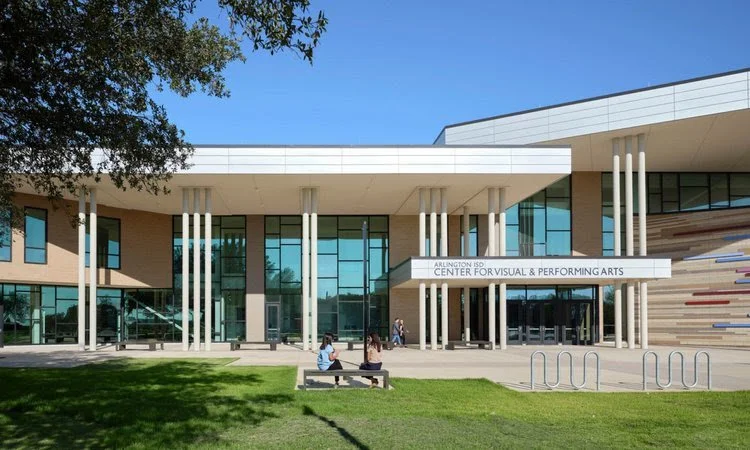
Arlington ISD Dr. Marcelo Cavazos Center for Visual and Performing Arts. Arlington, Texas.
This isn't about exercise or sustainability or the particular virtues of cycling. It's about what mode of arrival makes a pause structurally possible — and what a pause makes possible after that.
Researchers studying school entryways have found that the physical features of entrance areas play a significant role in how children and adults interact, engage, and feel in their schools — and that architectural choices either enable or limit what they call "bumping up": the casual, unplanned contact that builds familiarity over time. The car loop eliminates bumping up entirely. Not because anyone intended to prevent community. Because they were solving a different problem — traffic — and community was collateral.
The six minutes on the bike are where invitations travel. Where you learn which families are struggling and which are celebrating. Where the slow accumulation of recognition builds into something that functions as a neighborhood even when the houses are spread across different streets.
Twice a day, five days a week, the same people converging on the same place. Whether that convergence produces anything depends almost entirely on whether the design allows for a pause.
The car loop says: keep moving. The bike says: you have a minute.
And in that minute, something begins.
How do you arrive at the recurring moments of your week — the places you have to be, with the same people, again and again? What would change if you arrived differently?
Stay curious and connected,
Erin
Further Reading
A few insightful resources to help you explore how casual connections and physical spaces influence relationships and opportunities.The Strength of Weak Ties by Mark Granovetter — a foundational work on how weak social ties can open doors to new information and opportunities. Researchers studying school entryways — studies exploring how shared spaces and everyday encounters shape interaction, belonging, and community.